Hiển thị các bài đăng có nhãn Dean Stockwell. Hiển thị tất cả bài đăng

Thứ Ba, 23 tháng 9, 2014

The Legend of Billie Jean (1985)


The Legend of Billie Jean (1985)

Director: Matthew Robbins

Cast: Helen Slater, Christian Slater, Keith Gordon, Peter Coyote, Dean Stockwell, Richard Bradford, Martha Gehman, Yeardley Smith

So according to IMDB, Pat Benatar, the singer behind 'Invincible’, the theme song for The Legend of Billie Jean, supposedly introduces this song by saying “this song comes from the worst movie ever made”; a statement that I am strongly against! I mean, sure, nobody is saying that The Legend of Billie Jean is the best movie of all time or anything, but worst movie ever made? Come on!  This movie is one of the most quintessentially 80’s movies ever made! That’s what it is! And it’s got spirit and spunk! The soundtrack is awesome, and no matter how much Pat Benatar might hate this movie, her song gels to perfection with the film! “We will be Invincible!” It’s that spirit of us vs. them, the oppressed vs. the oppressor, the rebels vs. the system that gives The Legend of Billie Jean its cult status; it’s the reason why it’s gone on as long as it has. We the people identify with the heroically stoic figure of Billie Jean; she will not stand the abuse! She fights back! And she’s a woman! And she will take it no longer!


The films premise is an interesting one. Billie Jean and her brother Binx (Christian Slater in his first role) are two teenagers who enjoy the simple things in life: vanilla shakes, riding their scooter to the lake and basking in the sun as they muse about their possible futures. Their peace is disrupted when a group of rich bullies (read: total assholes) start disrespectfully hitting on Billy Jean. When she refuses their advances and Binx throws a strawberry shake in their faces, the bullies steal Binx’s scooter and take off with it. They later trash it, and give Binx a beating which leaves him all bruised and disfigured. That’s when Billie Jean decides to take matters into her own hands! She goes to the rich kid’s father and asks for the 608 dollars that its going to cost to  fix the bike, the rich bastard says he’ll give her the money little by little, in exchange for sex every time she comes. Billie Jean of course refuses! One thing leads to another and Binx ends up accidentally shooting the rich guy in the shoulder, so Billie Jean, Binx and their two friends run off together, avoiding the law and surviving in abandoned buildings and empty houses, becoming legends along the way. Will they get Binx’s scooter back? Will the rich asshole pay the money he owes? And can Billie Jean and company live on the run for long?


The Legend of Billie Jean is one of these movies in which adults don’t pay attention to the kids and their situations, which is kind of like a staple of movies from the eighties. Billie Jean actually goes to the police, who brush off her story as nonsense. They think it’s just a silly squabble amongst teenagers, but the teenagers are sick of being ignored by the adults, so they take matters into their own hands. The film has that spirity of young people wanting to change the world they are living in, they want to revolt and make things better. But the powers that be don’t want to let them do that, they don’t want teenagers revolting and saying what they think or feel. Billie Jean represents that voice, she’s the voice of her generation. And this particular generation she represents is the generation that was living through the Regan era, a time when capitalism/consumerism was rampant and money was king, it was a generation known as the ‘me’ generation. That selfishness, powered by greed is represented perfectly here.  The whole film is one big message against consumerism. Billie Jean becomes a hero to the people, so suddenly she becomes marketable, so suddenly everyone is selling Billie Jean T-shirts, hats, posters, bumper stickers, you name it. The ending of the film speaks loudly about what the filmmakers think of consumerism. Here’s a hint: they despise it. They see it as something that’s devouring humanity, spreading like a cancer, as we all know, they were absolutely right, consumerism has grown way out of control, it’s stronger and uglier than ever. If you don’t believe me, go to a Wal-Mart on Black Friday and watch people die. Billie Jean hates this money based society, she wants her 608 dollars, but at the end of the day, she hates the fact that this is all about money.


This film is b-movie stuff for many, and in many ways I’d say they are right, but in other ways, the film has a lot to say. Billie Jean identifies with Joan of Arc, she sees herself as a strong woman with a voice, she wants to be heard and treated with respect,  she’s standing up for herself. She wants her brothers scooter back and wants to make sure we are all treated fairly, its Billie Jean vs. the abused, in this case, her little brother and herself. I mean, it’s not just about getting the scooter or the money back, Billie Jean is also angry that she was almost raped by the rich greedy bad guy. At heart, this is a film about a woman standing up for herself and not taking the abuse anymore and that my friends, is something I applaud, even through all the cheesiness. Which by the way I find is one of the many charms this film has, it exudes a certain naiveté, a certain idealism and a passion to set things right. I love this kind of film, where the teens stand up to ‘buck the system’, yelling at the ones running the planet letting them know they are wrong. The Legend of Billy Jean can stand proudly next to films like Turk 182! (1985), Wisdom (1986), Footloose (1984), Heathers(1988) and Pump Up the Volume (1990), all movies where young people give the finger to adults and want to do things their way, which is usually fueled by heart, passion and justice; which is why I like The Legend of Billie Jean so much. It's about being fair with everybody, especially the poor. So the film also addresses classist issues, it's the rich vs. the poor here and the poor want to be treated with some respect. That's all, they want to be treated with dignity.  


Helen Slater nails it as Billie Jean, giving a rebel yell, screaming for all the kids, becoming their hero. Love that whole idea about kids helping each other, like a secret society of youngsters all backing each other up. Like youth existing on a whole other level that adults don’t even know about, it kind of makes me wanna be a teenager again! Watching this movie takes me back to my teenage years. Yeah, I was a kid when this film first came out, I was about ten, so Billie Jean in many ways became a voice for me, I was right there following her with all those other kids. Of course, now the film seems a bit cheesy to me, but I can see past its flaws because to me, it’s more about the feeling, the passion and the ideas that the film projects, it’s that idealistic way of seeing the world, it’s about the way we’d like things to be. What I wouldn't give for everybody to collectively want to produce a significant change in society, to change the status quo of things, or at the very least give it a try. Is it all that idealistic of an idea?    

Rating: 4 out of 5


Thứ Tư, 27 tháng 11, 2013

Dune (1984)


Title: Dune (1984)

Director: David Lynch

Cast: Kyle MacLachlan, Sean Young, Max Von Sydow, Dean Stockwell, Sting, Patrick Stewart, Jurgen Prochnow, Jack Nance, Virginia Madsen, Richard Jordan, Jose Ferrer, Brad Dourif

David Lynch’s Dune is a film that is hated by many but loved by another many, it’s a film that divides people, a love it or hate it type of thing, though if you ask me, there’s very little to hate about Lynch’s Dune. I’ve loved this movie ever since I was a kid, I didn’t fully “get it” back then, but there was something I liked about it anyways, my young mind recognized it as a special film. Dune is a film that I have revisited many times over in my life; it’s become one of those films that I will always love. Many years after I first discovered it, I read the book and appreciated the film on a whole other level. Considering the complexity of the book, I applaud Lynch for taking this gargantuan story and transferring it to the big screen because it was never going to be an easy job, the story that Frank Herbert weaved is epic, always has been, yet Lynch took it upon himself to film the thing, he even wrote the script himself! Many directors tried and failed for whatever the reason (Jodorowski and Ridley Scott being two of the filmmakers that didn’t end up directing) yet Lynch stuck to his guns and took the project head on. He even rejected an offer to direct Return of the Jedi (1983) in order to make Dune! Can you imagine what Return of the Jedi might have been like had Lynch directed it? Yeah, I know, the idea of Lynch playing with the Star Wars universe boggles the mind, yet I’m happy he ended up directing Dune instead because in many ways, Lynch was the perfect director for this project, especially when it comes to the more mystical aspects of the story, the telepathic abilities, Lynch had the perfect sensibilities for the more “weird” aspects of the Dune saga.


Herbert’s classic science fiction tale of politics, witches, religion and rebellion is one of those science fiction novels that any self respecting science fiction fan should tackle at some point in their lives. It really is one of the best designed fictional worlds; Herbert really constructed a fascinating, complex universe you can easily lose yourself in, a world filled with mysticism and inner dialog, of prophecies, false gods and abusive governments. The story of Dune is an all encompassing tale that covers many important aspects of our society, as you can expect, like all good science fiction, our way of life is mirrored in the story. For example, one of the main themes of the book revolves around religious fanatism, because after all, the story of Dune is one about a messiah coming to free his people, but that’s just the tip of the iceberg in this fantastic tale of liberation. You see, Dune is one of those books that is so complex that Herbert created a unique lexicon just for these books. So if you ever decide to read it, just remember your going to be introduced to a whole glossary of words unique to the Dune books, in fact, just in case you get lost, the book actually includes a glossary of Dunewords! Words like “Kwisatz Haderach”, “Benne Gesserit Witches” and last but not least, the “Spice Melange”, but same as reading Anthony Burgesses’s A Clockwork Orange which also created its own lexicon, all the new words will end up making perfect sense to you by the time you finish reading the book.  So I highly recommend checking this novel out to all sci-fi fans out there. As with any book to film adaptation, the question remains, was the film a good adaptation of the book?


I’d say that yes, it in deed was a good adaptation of the book. In its essence, the film tells the story of the liberation of the Fremen and the rise of Paul Moadib as ruler of the known universe. And this is coming from me, a huge fan of Frank Herbert’s Dune books! I’ve read almost all of them (still need to read the last one Chapterhouse: Dune) so I can say that yeah, Lynch’s adaptation was faithful for the most part. The only area in which he ended up changing things just a bit was in the last five minutes of film, but the rest of the film is pretty much the book. Of course, quite a few things were left out of the book in order to deliver a two hour movie. Speaking of which, the only real problem for me with the film is that if you’ve read the books, you’ll feel as if you’re seeing the story in fast forward. Truth be told, this book has enough story going for it to make two movies, but what Lynch did with the script and what the producers did when they edited the film themselves was compress the whole story into one movie; a pretty daunting task if you ask me. At the end of the day, the film kept the spirit of the book; even Frank Herbert himself complimented Lynch on the film. Herbert mentioned that he was mostly happy with the film, except for the ending which is where Lynch turned things around towards the more theatrical. You see, in the book, Paul Atreides is a man playing to be a god, without in fact being one; he recognizes the power that being a god to the masses represents, so he uses that to the peoples advantage. But the way the film ends, it makes him look like he is actually a god with powers like making it rain on planet Arrakis. This is why Herbert himself said that while he liked the film, he says that Lynch got the ending wrong. “I have my quibbles about the film, of course. Paul was a man playing a god, not a god who could make it rain” So this is really the only real difference between the books and the film. Though the ending of the film has an impact, and makes Paul Atreides a more powerful character, the problem with it is that Lynch’s ending changes the whole character around going against the actual message that Herbert was trying to put across with his book, that religion is a powerful farce used to control the masses.


In retrospective, considering how much of the story Lynch actually shot, they should have taken the opportunity to film two movies back to back. Lynch filmed enough of the story to make a four hour long movie! That’s right my friends, Lynch’s original cut of Dune was four hours long! So they might as well have split the thing in two and released it as two movies, kind of like what Tarantino did with his Kill Bill movies. But no, instead the producers decided to take the film away from Lynch and edit it down to two hours and seventeen minutes, which is one of the reasons why Lynch disowns this movie. It’s the one he considers a ‘failure’ in his career. In my opinion the resulting film is not a bad one and very far from being a failure. Lynch had shot too much good stuff for it to be bad; the result was going to be good no matter what. But obviously, had Lynch had final cut of the film, it would have been better. This is the main reason why Lynch has always denied participation in any of the dvd releases of the film. I’m wondering if maybe one day we’ll get a director’s cut of the film; which simply put, would be awesome! But considering how Lynch refuses to even talk about this film, well, I’m guessing we’ll never see that happen. As of my typing this review, there are three versions of the film, each varying in length. There’s the theatrical cut, the extended cut you get to see on television and then there’s the special edition version. The most complete one is the special edition version because it includes many scenes that were deleted from the original theatrical cut, which is a nifty extra for any Dunefan. But out of all the versions, I still prefer the original theatrical version best, it’s the one I have always known and loved. But true Dune fans will get a kick out of seeing all those scenes that were left out of the original theatrical cut.  


Lynch considers it painful to even talk about Dune! I can understand why, here’s a movie that took three years of Lynch’s life to make! This was a huge, huge production. Funny how gargantuan productions like this one often times end up in failure! To have so much of your life invested in a film that would ultimately end up not being truly yours can be a huge let down for any director, but such is the nature of big budget productions; it’s the producers or the studio who have the final say, they put up all the millions so that should not suprise anyone. Speaking of which this here movie cost something around the vicinity of 40 million dollars, yet strangely enough, it looks more expensive than some of today’s 200 million dollar movies. The art direction is truly impressive on this film! Dune was made in a time when sets were completely built, not half way digitized like most of today’s films. The film required a crew of 1700 people! 80 sets were built in 16 sound stages! I mean this movie was huge in every way you look at it; and what about that cast? So many amazing actors! And here’s this big budget movie being made by a director used to working on small budgets. The film proved to be too big for Lynch who obviously works better with smaller, more personal material. Still, if you ask me, I think the film we ended up getting is a great slice of science fiction.


Speaking of the different adaptations of Dune, there was a mini-series from director John Harrison which was actually extremely faithful to the books. From a fans point of view, John Harrisons take on Dune was an extremely complete adaptation, he even went further than Lynch’s films and adapted both Dune Messiah (the second book in the series) and Children of Dune (the third book in the series) by making a second mini-series entitled Children of Dune (2003), which by the way was also pretty good. These television mini-series, though faithful, lack the lavish production values of Lynch’s film, which is one of the things I love the most about Lynch’s Dune: how big budget it is! Speaking of the cinematic future of the Dune series, director Peter Berg (Hancock, The Kingdom) attempted a remake a while back and was actively involved in it for more than two years, but stepped down in order to direct Battleship (2012). I know that doesn’t make much sense but that’s what happened! My take on it is that Berg was probably trying to make a commercial film that would make tons of money so that he could then go on and make Dune, unfortunately, Battleship was a huge ass loud flop! So those plans went down the drain. As I type this Pierre Morel, the director behind Taken (2008) and District B-13 (2004) was the last director attached to the project, but so far nothing has come of it, here’s hoping it happens, I’d love to see the Dune universe resurrected for a new generation.


Rating: 5 out of 5

    FOR A DETAILED ANALYSIS OF ALL THE TIMES DUNE WENT IN AND OUT OF PRODUCTION, AND ALL OF THE DIRECTORS AND PRODUCERS THAT FAILED TO MAKE THIS FILM ADAPTATION BEFORE LYNCH GOT A HOLD OF IT, VISIT RADIOATOR HEAVEN WHERE MY BUDDY J.D. LAFRANCE GIVES A DETAILED REPORT ON THE WHOLE STORY IN AN ARTICLE ENTITLED: DUNE: IT'S NAME IS A KILLING WORD.

Keep your eyes peeled for David Lynch's cameo as one of the Spice Miners! 

Thứ Ba, 12 tháng 11, 2013

Blue Velvet (1986)


Title: Blue Velvet (1986)

Director: David Lynch

Cast: Isabella Rossellini, Dennis Hopper, Laura Dern, Kyle MacLachlan, Dean Stockwell, Brad Dourif, Jack Nance

Blue Velvet came around the time when Lynch was trying to bounce back from the financial disaster that was Dune (1984). Now if you ask me, I’m one of the ones that loves Lynch’s Dune, always have and always will,but more about that on my review for Dune! So for whatever the reason, audiences just didn’t engulf Lynch’s vision of Frank Herbert’s Dune universe. Did this mean Lynch was a bad director? Hell no, he’d already proven himself to be a force to be reckoned with Eraserhead (1977) and the incredibly moving The Elephant Man (1980), both mind blowing in their own ways. Dune was just a hiccup along the road. Dune tanking at the box office was not going to stop Lynch from making more movies. So, thanks to the benevolent help of producer extraordinaire Dino DeLaurentis, Blue Velvet got the green light. The trick to getting this film made was making it for very little. Blue Velvet was a risky picture to commit to because it dealt with both sex and violence and it was a very dark picture. Some sacrifices were going to have to be made if Blue Velvetwas ever going to see the light of day, and so, with everyone getting a pay cut, Blue Velvet was made with a mere six million dollars.


On this film we meet Jeffrey Beaumont, a college kid who’s coming back home to see his father who’s suffered from a devastating stroke. While wandering through his old neighborhood, Jeffrey stumbles upon a human ear decaying on the grass. Jeffrey is a good natured kid; he has a very positive, generally happy outlook on life, you get the feeling that he hasn’t seen enough of the world to become bitter and angry. Jeffrey is also a naturally curious young man, so he picks up the ear and takes it to the police, who decide to investigate further. Problem is that Jeffrey thinks he can investigate faster on his own, so he takes it upon himself to go deeper down the rabbit hole. Where will his investigations take him, especially considering the strange world we live in?


Blue Velvet is all about sex and violence, and how sometimes both of these worlds can get entangled to the point where they are difficult to differentiate. At which point are you "roughing it up a little" during sex and at which point does sex become sadomasochistic? Jeffrey Beaumont is a character who is exploring his boundaries, he wants to see that dark side of life that he’s never seen, he wants to see what’s hidden underneath, the taboos, the things no one wants to talk about. This is one of the defining themes of this film; that maybe the picture perfect world we see in front of our eyes isn’t as picture perfect as we’d like to think. I loved how Lynch mixes snap shots of a suburban neighborhood, picket fences, flowers and shinny new cars, with the horrors that are hidden underneath it all. Here, Lynch shows society living a façade. On the surface we see beauty, but if we look just a bit deeper, we see there are some pretty nasty things going on in this world. An example of this is Jeffrey, walking about this grassy knoll only to find a dead, decaying human ear when he decides to look where he’s walking. There are many references to darkness beneath the light in the film, for example, we see the picture perfect neighborhood, while inside of the houses, people are watching violent mystery stories on television, alluding to humanities allure with violence.


On the sexual side of things is where Blue Velvet really takes off though. We are presented with Jeffrey Beaumont and his new girlfriend Sandy Williams (18 year old Laura Dern) both of whom represent innocence and purity. They are so pure that they can’t stop giggling all the time; they can’t help being excited by the mystery that’s unfolding before them, like two little kids. They learn the hard way that some things are better left alone. On Blue Velvet, Jeffrey’s “innocence” is corrupted when he meets Dorothy Vallens, played by Isabella Rossellini, a battered character that’s emotionally and psychologically broken. Rossellini conveys all these emotions wonderfully through her performance which comes off as a woman who can’t escape the darkness she’s in, she’s gone in too deep; to top things off, she’s grown into a masochist. This desire to get pleasure from pain comes as a shock to Jeffrey, who’s only about caring for others. While Jeffrey asks “are you okay?” to Dorothy, she asks him to hit her. So we have to diametrically opposed characters, attracting each other because of their differences. Jeffrey is attracted by Dorothy’s intensely erotic nature while Jeffrey’s tenderness is something new to her. He’s a good natured kid getting mixed up with a damaged soul.  So these two worlds are clashing with each other, there’s no way that Jeffrey is going to come out unharmed from all of this. Yet there’s nobility to Jeffrey. He doesn’t have to get mixed up in this, but he does, because he feels sympathy for Dorothy. By the way, this is a very vulnerable performance from Rossellini, she bares all in a character that’s worth exploring.


Enter Frank Booth, one of the most evil, dark, twisted characters you will ever meet on any film. He’s the kind of character that comes off as truly scary, Frank will make you scared of the idea that there are people like him roaming the world. Dennis Hopper delivers an amazingly demented performance, very intense. He represents the worst thing that a man can become and that’s abusive of women. And this is one of the most important questions the film asks: “Why are there people like Frank in the world?” There's a scene where we are in the backseat of a car as Frank Booth is driving, Dennis Hopper plays it so evil that you get this feeling that you do not want to be there! Why are their people so messed up that they have to abuse women? That they get pleasure out of inflicting pain? Men who have to show that they are the alpha males, that they are the ones with physical power and that they can abuse it. With Blue Velvet Lynch once again addresses the theme of psychologically and physically abused women. He also played with these themes in Inland Empire (2006) albeit in a slightly more surreal fashion, but it’s in Blue Velvet that he explores them most deeply. Isabella Rossellini is the poster child for abused women as Frank Booth is the poster child for abusive men. I did like how not all men are portrayed as abusive, because while Frank is all that can be evil about a man, Jeffrey is the complete opposite. He cares for women and wants to show them tenderness and care.  


Women have always made up a huge part of Lynch’s body of work. Twin Peaks: Fire Walk With Me (1992) is yet another film about abused girls. Mulholland Dr. (2001) also centers on women. Same as Federico Fellini, women are a favorite topic of Lynch’s and same as many Fellini films, an admiration, an adoration of the female is felt. There are many other elements to Blue Velvet that will remind you that it’s a David Lynch film; the art direction, the colors in a room, the mellow lighting, the peculiar looking lamps; that droning sound and same as in many Lynch films, somebody singing a sad song from a stage will always figure into the story, in this case its Isabella Rosellini herself who will hypnotize you while singing ‘Blue Velvet’. Lynch’s love for a good mystery is also at the heart of Blue Velvet. We discover this intricate mystery as we follow Jeffrey, deeper and deeper into this dark, dark world. Also, there are wonderfully weird moments that will let you know you’re in Lynch territory, like this scene in which Dean Stockwell sings Roy Orbison's 'In Dreams', wow, now that's weird! These scenes will stir emotions in you that you didn’t know you could feel, and that’s what is so great about Lynch. He creates premises so strange, so surreal that they’ll trigger an emotional reaction out of you, even if you don’t fully comprehend what you are seeing. But speaking of coherence, Blue Velvet is actually one of Lynch’s most linear films; it just goes into really strange, dark places. But, like any good mystery, you’ll end up loving it and wanting to see it all the way through, like Jeffrey,  Lynch will turn you into a voyeur who can’t stop watching.  

Rating: 5 out of 5     


Thứ Tư, 28 tháng 10, 2009

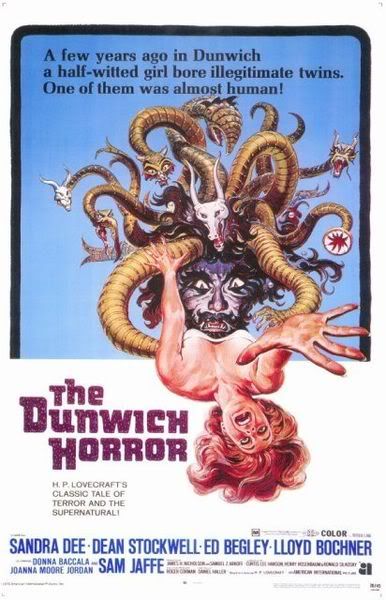
The Dunwich Horror (1970)


Title: The Dunwich Horror (1970)

Director: Daniel Haller

Stars: Sandra Dee, Dean Stockwell

Review:

I'll start this review by saying that Ive read quite a few of H.P. Lovecraft's stories and that I love them. A lot of them are about otherwordly creatures who used to dominate earth once upon a time and now they are looking for a way back in, to conquer and dominate the earth once again. Essentially, this movie plays with these Lovecraftian themes, only thing is that it does it with a distinctively cheesy Roger Corman b-movie feel to it. Was the film any good? Did it pay respects to the H.P. Lovecraft short story that inspired it?


Well first lets start out with the story, wich was about this guy called Wilbur Whateley, who is very interested in 'The Necronomicon' a.k.a. The Book of the Dead. He has a downright voracious appetite for it! He needs to read it because this book explains how to bring "the Old Ones" here to earth. He goes to the Miskatonic University (which actually has one of the few copies of the book) and ask for it, to inspect it closer and read a few of the passages that let him know what he has to do to bring "the Old Ones" back. While there he meets (and enchants) Nancy Wagner a young girl to wich he is strangely attracted to. He basically plays a jedi mind trick on her and manages to convince her to go with him to his old mansion in the town of Dunwhich. You know, for the weekend. Soon after that, he decides he will use her to perform a ritual wich will bring "The Old Ones" back to earth and therefore bring upon the destruction of the human race!


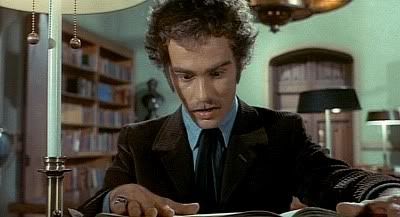
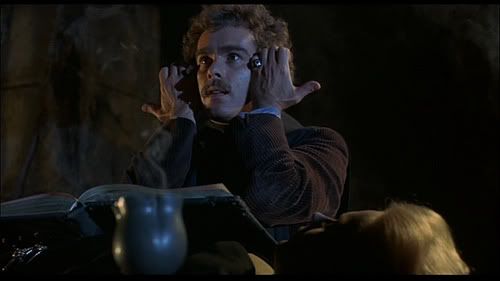
The Dunwich Horror has this really weird aura to it. Its got a weird feeling of unease and a lot of that has to the with Dean Stockwells eerie and quirky performance as Wilbur Whateley. He is so quiet and mild mannered yet you get the feeling that he has some dark purpose to his actions...you get the feeling that something is not quite right with this guy. Theres something in that look that he gives that is unnerving. Then of course this being a movie based on an HP Lovecraft story that "weird feeling" feels just right. Like many of Lovecrafts stories this movie has that feeling of going into the unknown, of discovering an otherwordly thing that has existed for eons yet we know nothing about. Of knowledge of the universe that could drive you MAD!

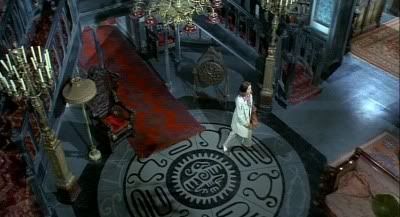
One of the best things about this movie is its art direction and its ligthing. As we all know, these are two very important aspects of any good horror movie. The ligthing sets the mood, and in this movie we get dark corridors, filled with shadows and mysterious rooms. The interior of the mansion itself is pretty effective. Lots of old books, statues ancient runes. Love that about the movie! Theres this really eerie scene where we get to see the mansion from its exterior and the house is creeking and making all these weird sounds, and everything looks rotted and ugly, this type of thing just makes everything all the more spookier. What I liked about it as well is that the film was shot near the Ocean, which is perfect for any film of Lovecraftian nature. Remember, Lovecraft was sometimes about ancient creatures coming out of the ocean, like in Stuart Gordons Dagon, another excellent Lovecraftian film.


This movie is vaguely similar to H.P. Lovecraft's original tale. Lovecraft's original story concerns a small town in the middle of nowhere. In that story, the people of a small town out in the sticks are freaked out because something appears to be living in the nearby woods, something alive, something that smells bad, something that burns the woods to a crisp! What is it? Many people think it could be the offspring of that weird Whateley family! Thing is, that the film is very different in tone, and changes many situations around, so do not expect a faithful adaptation of the book. Simply expect a film that was inspired by it. Something that exists within Lovecrafts universe. Characters end up talking about the Necronomicon, The Miskatonic University and "The Old Ones" so lovers of Lovecraft should feel quite at home with this movie even though its not really a faithful adaptation of the story its inspired by.


In many ways, this film feels a lot like The Wickerman, Silent Hill or Rosemarys Baby. The kind of movie were you know something werid is going on, but your not quite sure what it is. Thats the vibe I got when I saw Wilbur pulling his dirty tricks on Nancy, slowly luring her into his world. Same deal with all these other movies about weird cults, at first the bad guys charm you and pull you in, then they pull out their claws and you end up on the sacrificial altar. Thats the vibe with this movie, movies like that always get under my skin.


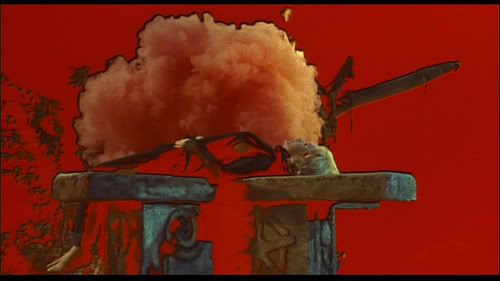
Then theres "The Old Ones", the creatures that are trying to come into our world and take over. Theres this build up in the film, all this talk about these creatures that impregnated Wilbur...and Wilbur might actually be one of them, so kind of get restless to see the damned things. Well, the creature finally appears in the film, unfortunately, this is where I was completely dissapointed with the film because the monster is a cheap cop out. All we see is the monsters point ov view, which consists of a bunch of psychodelic colors flashing on the screen. Its ultimate purpose is to not let you get a good look at the cheap ass monster they made for this movie. They dont really let you get a good look at the damn thing, and as we all know that is the sign to look for when a film is ashamed to show its creature. When the make up effects guy couldnt come up with something that would look decent on screen, they try not to show it too much. Kind of like those Predaliens in Alien vs. Predator: Requiem.


But ultimately, this is not a bad film! What saves it is Dean Stockwells performance! Its so over the top and spaced out, that it keeps you glued to the screen. And when he dons those ceremonial garments and is getting ready to sacrifice the virgin in an altar to the Old Ones, I was a satasfied Lovecraft fan. I was just so damn dissapointed with that cop out on the creature, otherwise, the film is great. It has great atmosphere and a cool story going for it.

Rating: 3 out of 5